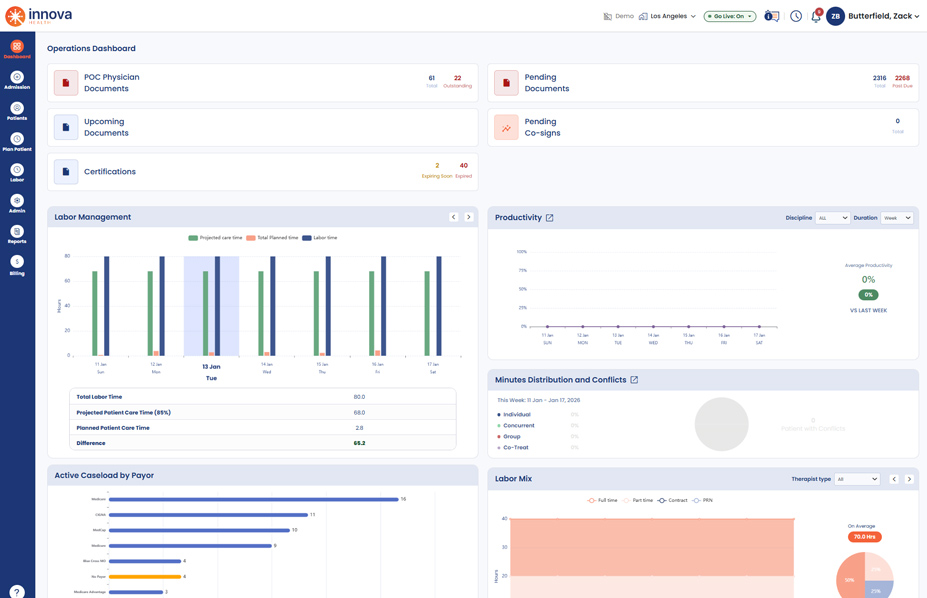
The Patient Driven Payment Model (PDPM) has been the dominant SNF reimbursement model since October 2019. Six years in, the operational expectations are clearer — and so are the audit findings, denials, and recoupment patterns that catch underprepared therapy teams.
This is the practical checklist for SNF therapy directors heading into FY 2026. Twelve items to confirm your documentation, workflow, and compliance posture are where they need to be. Plus context on what changed in FY 2026 and what to watch for in FY 2027.
What is PDPM compliance for SNF therapy?
PDPM compliance for SNF therapy is the set of documentation, workflow, and oversight practices that ensure therapy services are delivered, documented, and billed in alignment with CMS’s Patient Driven Payment Model rules. This includes accurate MDS data, proper PDPM case classification, defensible therapy documentation, group and concurrent therapy minute compliance, recert and discharge timing, co-signature workflows, and audit-ready records. Compliance isn’t a separate function; it’s how SNF therapy operations work day to day.
What changed in FY 2026
The FY 2026 SNF Final Rule (effective October 1, 2025) introduced several changes affecting therapy operations:
- Wage index updates affecting reimbursement at the facility level
- PDPM rate adjustments based on the latest cost data
- Continued enforcement focus on documentation defensibility and audit response readiness
- Quality reporting program updates affecting therapy outcomes measurement
- For specific FY 2026 rule details, refer to CMS’s published documents or our Innova Chats episode breaking down the FY 2026 SNF Rule
Bottom line for therapy directors: the macro PDPM framework hasn’t changed; the enforcement environment has tightened slightly, and audits remain a real possibility.
The 12-point PDPM compliance checklist
Use this as a self-audit. Each item is a yes/no checkable point with a brief explanation.
1. Are you documenting therapy time at the activity level, not just the session level?
PDPM-defensible documentation requires showing what specific activities the patient completed during a therapy session — not just “PT 45 minutes.” Activity-level documentation supports both compliance and case mix accuracy.
If your therapists are writing “ROM, gait, transfers” as session content, you have a defensibility gap. Auditors expect to see how long each activity took and what clinical decisions were made.
2. Are recerts signed within the CMS-required window?
Therapy recerts are required at specific intervals. Late recerts trigger denials. Your system should alert therapists and supervisors well in advance of recert deadlines, not as they expire.
Innova’s Patient Planner surfaces recert timing automatically. Manual tracking via spreadsheets is the most common source of recert misses.
3. Are co-signatures completed before billing?
Documentation requiring co-signature (typically PT/OT/SLP evaluations and certain re-evaluations) must be co-signed before billing. If your billing process generates invoices for documentation pending co-signature, you have an audit risk.
Pre-billing edits should catch this; manual co-signature tracking inevitably misses some.
4. Is your Triple Check actually a triple check?
The Triple Check process requires three independent reviewers verifying MDS, billing, and documentation alignment. “Triple check” performed by the same person three times is not a Triple Check. CMS auditors look for evidence of independence.
If one therapy director is doing all three reviews because of staffing constraints, document the workflow but recognize the defensibility gap. Plan to staff appropriately.
5. Is group therapy actually group therapy?
CMS defines group therapy as 1 therapist working with 2-4 patients on similar therapy goals at the same time. Common findings:
- More than 4 patients in a group session
- Patients with disparate goals lumped into one group
- “Group” therapy that’s actually concurrent or co-located individual sessions
Each finding affects billable minutes and case mix.
6. Is concurrent therapy properly identified and within the 25% allowable?
Concurrent therapy (1 therapist : 2 patients on different therapy programs simultaneously) is allowed up to 25% of total therapy minutes per discipline per stay. Exceeding the 25% threshold triggers audit findings.
Track concurrent therapy minutes by discipline in real time, not just at month-end. Innova’s group/concurrent planner enforces the 25% rule automatically.
7. Are you tracking the right MDS data points?
PDPM reimbursement is driven by MDS data. Inaccurate or incomplete MDS data on Section O (Special Treatments), Section GG (Functional Status), or PDPM-specific items distorts case mix and reimbursement.
Therapy directors should partner closely with MDS coordinators to ensure therapy-relevant data flows accurately into MDS.
8. Are PT/OT/SLP minutes mapped correctly to PDPM cases?
Therapy minutes drive PDPM case mix categories. Mis-categorized minutes (e.g., labeling individual therapy as group, or vice versa) result in case mix errors that auditors flag.
Your system should not allow miscategorized minutes; if your current EHR allows it, your defensibility posture is weaker than it should be.
9. Are clinical decision rationales documented?
For each therapy intervention, the documentation should support why the intervention was chosen, what was expected, and whether the goal was met. “PT 45 min, made progress” is not defensible. “PT 45 min focused on gait training with FWW per fall risk; patient ambulated 50 feet with min assist; no decline from prior session; continuing per plan of care” is.
Audit findings on rationale documentation are among the most common.
10. Are you running pre-billing edits?
Pre-billing should catch:
- Missing co-signatures
- Late recerts
- Concurrent therapy exceeding 25% threshold
- Group therapy with >4 patients
- MDS-therapy minute mismatches
- Missing PDPM case assignments
Innova’s pre-billing module runs these automatically. Manual pre-billing review is workable but tedious and error-prone.
11. Are you analyzing audits and denials for patterns?
Individual denials are noise. Patterns are signal. If 30% of your denials this quarter are related to recert timing, your workflow has a recert problem.
Quarterly audit-and-denial pattern analysis surfaces these systemic issues. Most facilities don’t do this systematically; the ones that do reduce denial rates 20-40% over 12 months.
12. Are you keeping an audit trail your auditors can follow?
When CMS, RAC, or commercial payer auditors arrive, they want to follow a chain: MDS → therapy documentation → billing → reimbursement. Every step should be supported by accessible records.
Cloud-based EHRs with integrated billing provide this chain natively. Legacy systems with disconnected modules force manual audit responses, which take days or weeks.
Common audit findings — and how to prevent them
Patterns that surface repeatedly in CMS and RAC audits:
Finding: Inadequate clinical rationale
- Why it happens: time pressure on documentation; templates that don’t prompt for rationale
- Prevention: clinical libraries with prompts; periodic chart reviews for rationale quality
Finding: Group/concurrent therapy minute violations
- Why it happens: manual minute tracking; pressure to maximize therapy minutes
- Prevention: system-level enforcement of group/concurrent rules; real-time visibility for therapy directors
Finding: Recert/discharge timing misses
- Why it happens: manual tracking; therapist caseload pressure
- Prevention: automated alerts in the EHR; daily director dashboards on upcoming deadlines
Finding: Co-signature gaps before billing
- Why it happens: billing runs before all co-signatures complete; manual gatekeeping
- Prevention: pre-billing edits that block billing on missing co-signatures
Finding: MDS-therapy minute mismatches
- Why it happens: data flows poorly between therapy EHR and nursing EHR
- Prevention: full API integration between systems (not manual reconciliation)
The compliance burden can be carried in two ways: with extensive manual workflows (spreadsheets, daily director meetings, monthly reconciliation), or with a therapy EHR that embeds compliance into the workflow.
Innova’s approach is the latter:
- Built-in clinical documentation libraries that prompt for rationale
- Real-time group/concurrent therapy minute tracking with the 25% rule enforced
- Automated alerts for recerts, discharges, and co-signature deadlines
- Pre-billing edits that catch errors before invoice generation
- Triple Check workflow support with audit trail
- Full API integration with MatrixCare and PointClickCare for clean MDS data flow
If your current EHR doesn’t support these natively, the question is whether your compliance team can keep up with the manual workflow forever — or whether it’s time to switch to a system that supports them.
Learn more about Innova’s PDPM compliance module →
What happens when compliance fails
The cost of compliance gaps isn’t just abstract risk. Specifically:
- Cash flow impact: Denials and recoupments interrupt cash flow. A facility with 200 monthly therapy patients can lose $50K-$200K per year to preventable denials.
- Operational impact: Audit response is time-consuming. A single major audit can absorb 100+ hours of director time across documentation pulls, response composition, and follow-up.
- Staff morale: Therapists feel the impact of compliance gaps through extra paperwork, increased scrutiny, and the stress of audit cycles.
- Strategic impact: Repeat findings affect your relationship with payers and your standing with RAC contractors.
A modest investment in compliance infrastructure pays back quickly in avoided denials and recovered staff time.
What’s coming in FY 2027
CMS hasn’t finalized the FY 2027 SNF rule yet (typically proposed in spring, finalized in late summer). Watch for:
- Continued PDPM rate adjustments based on the latest cost reporting data
- Quality reporting program changes affecting publicly reported outcomes
- Potential workforce-focused rule changes given ongoing staffing pressure in skilled nursing
- Continued enforcement focus on documentation defensibility
When FY 2027 proposed rule lands, Innova will publish an analysis (subscribe to our newsletter or watch Innova Chats for coverage).
Frequently asked questions
What’s the difference between group and concurrent therapy?
Group therapy is one therapist working with 2-4 patients on similar therapy goals at the same time. Concurrent therapy is one therapist working with 2 patients on different therapy programs simultaneously. Different billing rules apply to each; concurrent therapy is capped at 25% of total therapy minutes per discipline per patient stay.
How long do you have to complete a recert in SNF therapy?
Therapy recerts must be completed at intervals defined by CMS and the patient’s plan of care. Specific timing varies by therapy type and case; consult CMS guidance and your facility’s compliance team for exact requirements.
Who needs to co-sign therapy documentation?
Co-signature requirements depend on the documentation type, the credentialing of the documenting therapist, and your facility’s policies. Initial evaluations and reevaluations typically require co-signature by a licensed therapist of the appropriate discipline.
What’s a Triple Check in PDPM compliance?
Triple Check is a three-reviewer process verifying that MDS data, therapy documentation, and billing are aligned for a given resident. The three reviewers should be independent (typically MDS coordinator, therapy director, and billing lead) to ensure each verification is genuine.
How does PDPM differ from RUG-IV?
PDPM replaced RUG-IV in October 2019. The major shifts: PDPM uses patient characteristics (not therapy minutes) to drive case mix; it covers a 100-day stay with variable per-diem rates that adjust over the stay; and it pays separately for PT/OT/SLP, nursing, non-therapy ancillaries, and other components rather than bundling.
What changed in FY 2026 SNF rule?
The FY 2026 final rule made wage index updates, PDPM rate adjustments, continued enforcement focus, and quality reporting updates. The macro PDPM framework didn’t change. See our Innova Chats episode for details.
Do small SNFs need a different compliance approach than chains?
The PDPM rules are the same. The operational approach can differ: small facilities often run more manual workflows because the volume is manageable; chains automate more because the volume isn’t. Both can be compliant.
Can a therapy EHR really make compliance easier, or is it just marketing?
A therapy EHR with native PDPM workflow can substantially reduce compliance overhead — typically 30-50% of director time previously spent on manual reconciliation. The biggest gains come from real-time minute tracking, automated alerts, and pre-billing edits.
Closing
PDPM compliance isn’t a one-time project. It’s the operational baseline of SNF therapy.
If your current EHR supports this baseline natively, you’re well-positioned. If it doesn’t — if compliance lives in spreadsheets and director-led reconciliation — there’s an upside in switching to a system that embeds compliance into the workflow.
Innova Health was built for this reality. See how Innova’s PDPM module works or schedule a working session with our team.
Further reading
Related Innova Health articles
External resources